The Rohingya, or the geography of misfortune
Dhaka
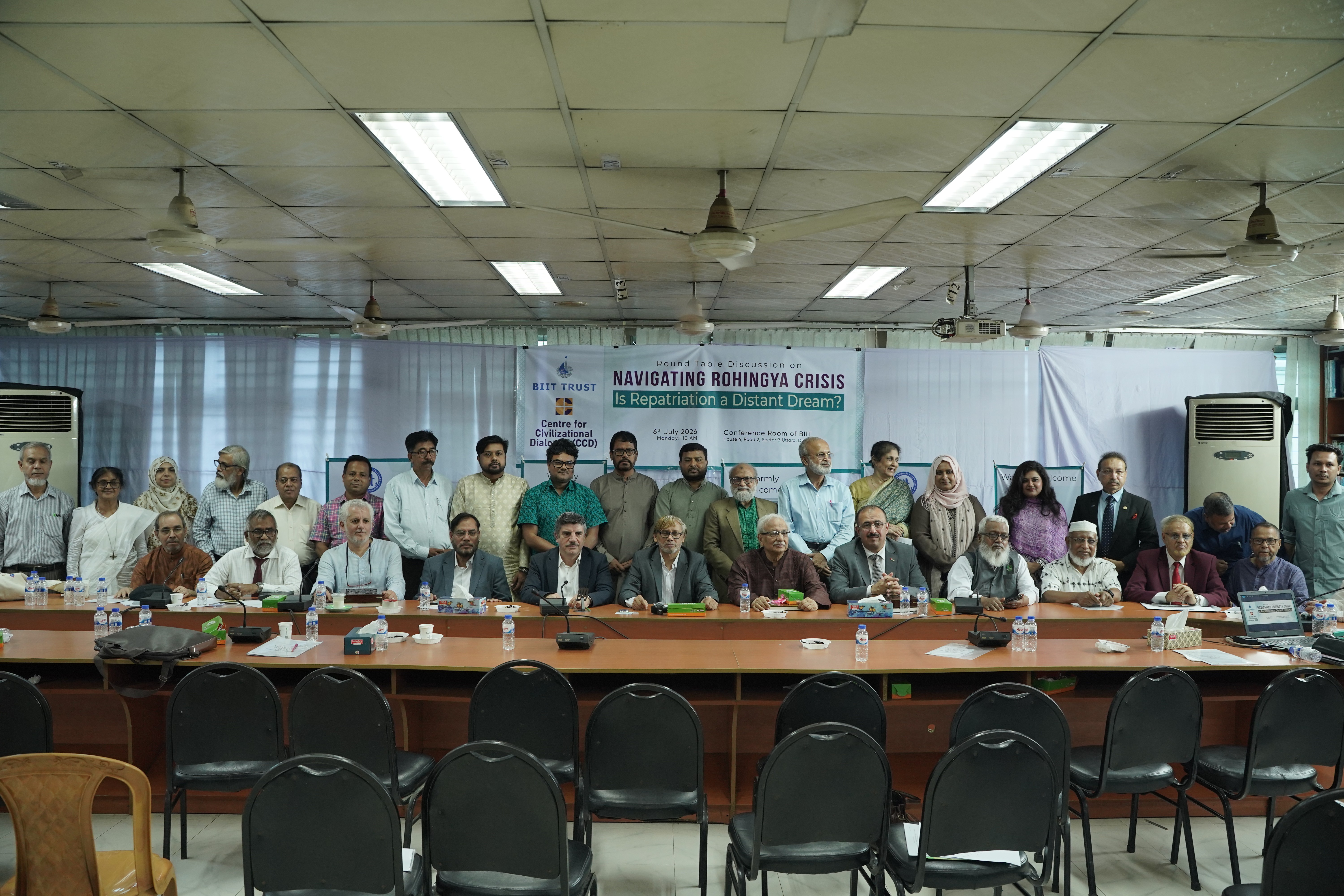
Participants attend the roundtable discussion in Dhaka, Bangladesh, June 2026. (Photo by Al-Ummah Desk)
On the occasion of the launch of the Al-Ummah website and magazine in Dhaka, the capital of Bangladesh, I was invited to take part in several conferences and meetings focusing on education as well as the major social and political challenges facing the country.
One of these gatherings was devoted to the plight of the Rohingya refugees. Organized by the Centre for Civilizational Dialogue and the Bangladesh Institute of Islamic Thought (BIIT Trust), the roundtable was titled "Navigating the Rohingya Crisis: Has Return Become an Unreachable Dream?"
As I listened to the contributions of researchers, representatives of civil society organizations and specialists gathered around the table, one conviction became clear to me: the tragedy of the Rohingya is one of the greatest humanitarian catastrophes of our time. In many respects, it echoes the tragedy of the Palestinian people. For many years, it has also resonated with the suffering endured by Syrians.
I approach this issue through the eyes of a Syrian, as someone who has experienced injustice, war, forced displacement and exile.
The dictatorial regime of Bashar al-Assad forced nearly half of Syria's population to leave their homes. Around 12 million people were displaced, either within the country or beyond its borders. Behind this staggering figure lie millions of shattered lives, families torn apart and futures left suspended.
Millions of Syrians spent years living in tents, sometimes convinced they would never see their homeland again. I still remember the statements of a senior military figure from the former regime, who publicly threatened those who had been forcibly displaced, declaring that if they returned, they would find nothing that would make them want to stay.
At that time, while Syrians were enduring their own tragedy, we were also following the fate of the Rohingya. We prayed for their suffering to end, and we saw in their pain an echo of our own. Yet one reality was impossible to ignore: their situation was even more desperate than ours.
I often find myself reflecting on the notion of the "curse of geography."
Syria has paid a heavy price for its geopolitical position. It has endured sieges, bombardments, hunger and destruction. Yet that same geography also offered Syrians avenues of escape. They were able to flee to neighboring countries — Jordan, Lebanon and Türkiye — before many continued their journey toward Europe. Many lost their lives along the way, and the Mediterranean swallowed thousands of dreams. But many others eventually managed to rebuild their lives elsewhere, with varying degrees of success depending on the countries that received them.
For the Rohingya, geography offered no such alternative. Arakan is wedged between Myanmar and Bangladesh. When they fled the campaigns of ethnic cleansing carried out by the Burmese military, the Rohingya had virtually only one possible destination: Bangladesh.
Despite its own economic and demographic challenges, the country opened its borders to them. History will undoubtedly remember this gesture, just as it will remember the generosity of the peoples who stood by Syrian refugees.
Yet one major difference separates the two tragedies.
Following the fall of Bashar al-Assad's regime, Syrians have gradually begun to find their way back home. Their return remains fraught with obstacles, but it has once again become a possibility. For the Rohingya, by contrast, that prospect remains almost beyond reach. This difference largely explains the depth of despair that now permeates the refugee camps in Bangladesh.
Under Sheikh Hasina's government, Bangladeshi authorities adopted an evolving approach to the Rohingya crisis. While continuing to advocate for their cause on the international stage, they gradually placed greater emphasis on security considerations and administrative control in the daily management of the camps. As exile continued, international aid declined, and economic and social pressures mounted, this policy progressively hardened — a trajectory also observed in several countries hosting Syrian refugees.
The political transition that took place in Dhaka has raised hopes for a more balanced approach, one more firmly grounded in humanitarian principles, transparency and respect for fundamental rights. Reducing the Rohingya to an economic burden or a security threat means overlooking the essence of the crisis. Before they became refugees, they were victims of a policy of persecution that deprived them of their citizenship, their rights and, ultimately, their homeland.
Yet there are no illusions: the future of the Rohingya will not be decided in Bangladesh. The solution does not lie in Dhaka, but in Naypyidaw.
Return is not simply a matter of crossing a border
This question lay at the heart of the discussions: Is the return of the Rohingya still a realistic prospect, or has it become nothing more than a distant hope?
No one disputes that the overwhelming majority of Rohingya wish to return home. But the real issue is not return itself. It is the conditions under which such a return could take place. Crossing a border alone does not bring exile to an end. Return only has meaning if it is accompanied by genuine guarantees: full recognition of citizenship, legal security, the restitution of property, protection from persecution and, above all, the restoration of human dignity. Yet none of these conditions exists today.
The Rohingya remain deprived of the citizenship that was taken from them. Rakhine State remains deeply unstable. Security guarantees are virtually nonexistent. Added to this is a new reality: The security landscape has become far more complex. Alongside the Burmese military, several armed groups are now operating in the region, and they, too, have been accused of serious human rights violations against Rohingya communities. Under such circumstances, imagining a safe, voluntary and sustainable return remains far more an aspiration than a reality. The discussions naturally reflected this tension.
Some participants stressed the urgency of creating the conditions necessary for return. Others reminded the audience that immediate needs could not be ignored: ensuring access to education, expanding health care services and creating economic opportunities for a population that has spent years living in camps where the future seems suspended.
The Syrian refugee crisis was shared, to varying degrees, by several states in the region. Türkiye, Lebanon, Jordan and, to a lesser extent, Iraq carried the weight of this massive displacement. Each developed its own approach to hosting refugees, but all eventually pointed to similar concerns: the economic cost, social tensions and the difficulties generated by a conflict that had dragged on for years. I will not dwell here on the validity or extent of these arguments.
Bangladesh, by contrast, bears almost alone the responsibility of hosting the Rohingya. This is what gives the crisis its particular dimension. Can one reasonably expect a developing country to shoulder indefinitely, and with almost no support, the human, economic and political burden of an exodus on such a scale? The answer is clearly no.
Humanitarian aid can no longer be the only response. It remains essential, but it cannot replace a genuine international political strategy.
The international community must assume its share of responsibility. It must exert meaningful diplomatic pressure on Myanmar's authorities to restore the rights of which the Rohingya have been deprived, above all their citizenship. It must also encourage closer coordination among the United Nations, the Association of Southeast Asian Nations (ASEAN), the Organization of Islamic Cooperation and all other actors capable of influencing the course of this crisis.
The world is currently experiencing a succession of wars, humanitarian emergencies and geopolitical upheavals that dominate international attention. Crises are multiplying, and with them comes the risk that certain tragedies will gradually fade from public awareness. This is precisely the danger facing the Rohingya today.
Yet there are tragedies that time does not make less painful. It merely makes them less visible. Recent history has taught us that a forgotten crisis is never a resolved crisis. It continues to produce its consequences in silence until the day it resurfaces with even greater force. The tragedy of the Rohingya belongs to this category.
Turning away from their suffering will not make the crisis disappear. It will only prolong the exile of a people deprived of their land, their rights and, for far too long, their hope of returning home.