Yunus Emre: The mystical poet who inspired the Turks
Yunus Emre: The mystical poet who inspired the Turks
Yunus Emre (1240-1321) was a mystical poet who devoted his life to spreading the message of love, brotherhood and spiritual harmony. His poetry profoundly influenced Turkish literature and spiritual thought, and he remains one of the earliest and most celebrated voices in Turkish poetic history.
Often regarded as one of Türkiye’s national poets, Yunus Emre emerged as a leading representative of early Turkish mysticism and a pioneer of devotional poetry rooted in spiritual reflection. Despite his immense fame, however, little reliable information survives about his personal life. Historians know only fragments: he is believed to have been born around 1240 in Sarıköy in the Anatolian region of present-day Sakarya province and to have died in 1321.
Although numerous historical and literary works praise Yunus Emre as one of the greatest poets of his age, they provide few details about his origins or early years. Most studies instead focus on his poetry and its enduring significance in Turkish folk literature and Sufi thought. Through his verses, however, one can glimpse the depth of his spirituality, his intellectual development and his close connection with the struggles and aspirations of ordinary people.
In recognition of his universal humanistic message, UNESCO commemorated the 750th anniversary of his birth in 1991 by declaring it “the International Yunus Emre Year.”
His life
Determining the precise influences that shaped Yunus Emre's character and worldview remains difficult because of the scarcity of historical documentation. Nevertheless, his poems reveal much about his spiritual journey and inner world.
Yunus Emre lived in Anatolia during the turbulent 13th and early 14th centuries, a period marked by Mongol invasions, the weakening of Seljuk authority and the early rise of the Ottoman state. Political instability, population displacement and social hardship deeply affected everyday life. Amid this uncertainty, people longed for peace, security and spiritual solace.
Amid these difficult circumstances, Yunus Emre emerged as a voice of hope. Through simple yet profound language, he spoke directly to ordinary people in their own tongue, encouraging faith, compassion and moral refinement. His poetry sought to awaken the soul and guide humanity away from hatred, corruption and despair.
Like Jalal al-Din Rumi (Mevlana), Yunus Emre believed that true spirituality lay in transcending worldly divisions and drawing closer to God through love.
His fame gradually spread far beyond his native region, reaching the Balkans and the Caucasus, and he became one of the most beloved representatives of moderate Islamic mysticism in Anatolia. Much of his poetry revolved around divine love and humanity's relationship with God.
One of his celebrated verses says:
“My name is Yunus Emre,
And each passing day fans the flames within my soul.
In this world and the next, I seek but one desire:
It is You alone whom I truly need.”
Yunus Emre the poet
Yunus Emre was a poet of the people. Although deeply influenced by Sufism, he remained closely connected to folk traditions and spoke in a language accessible to all. Unlike many scholars and poets of his time who preferred Arabic or Persian, Yunus chose to write in simple Turkish, strengthening his bond with ordinary people and helping lay the foundations of Turkish literary expression.
His language was graceful and emotionally rich, filled with vivid imagery, spiritual longing and reflections on life, death and human destiny. His poetry combined simplicity with profound philosophical insight, making complex spiritual ideas accessible to a broad audience.
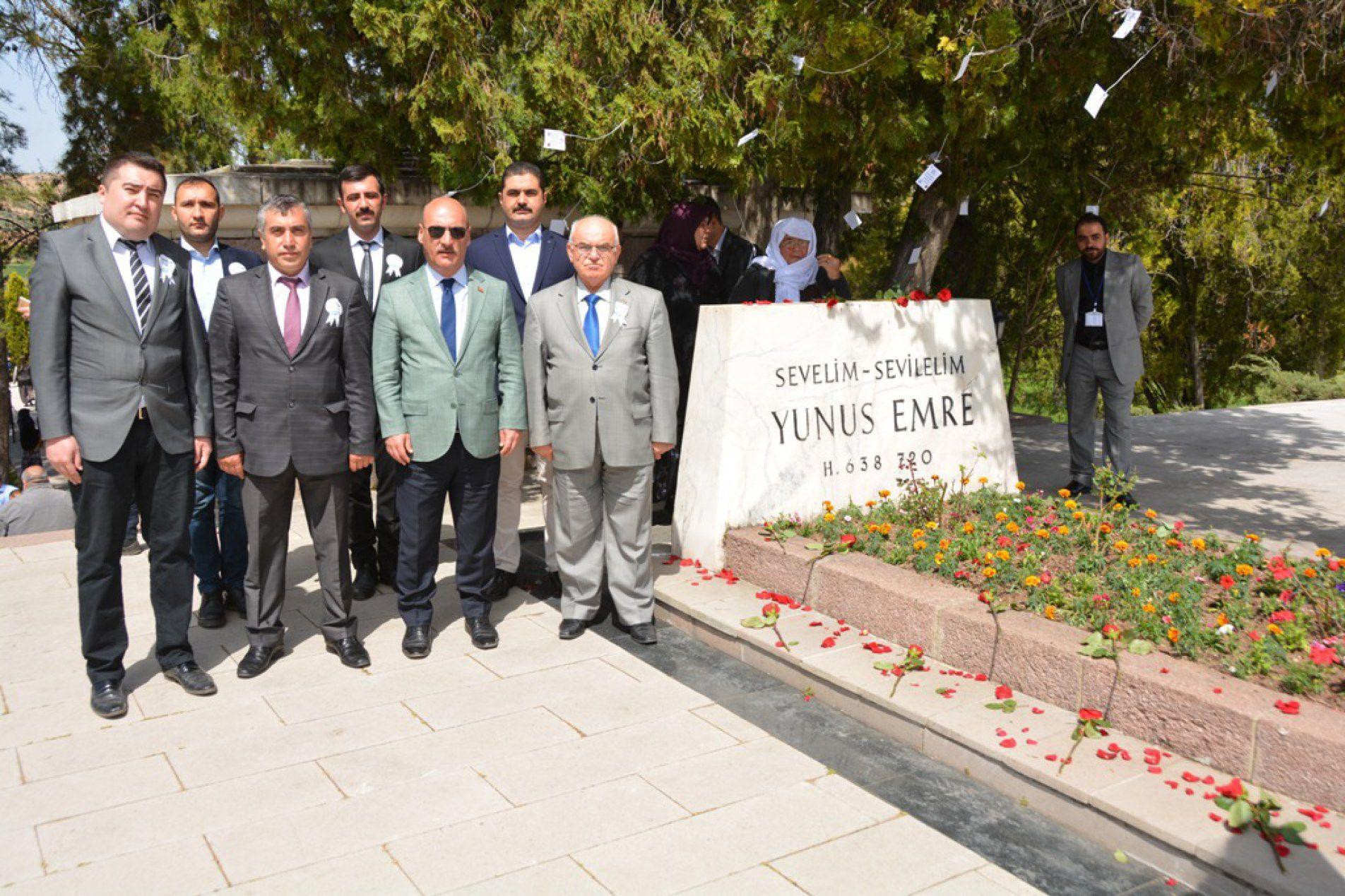
The people of Anatolia embraced him as a spiritual guide and national symbol. Legends about his travels spread across the region, and over time numerous shrines and tombs were attributed to him as expressions of popular reverence and affection.
In European literary history, he has often been compared to figures such as Dante Alighieri, Francesco Petrarca, and Desiderius Erasmus for his cultural and spiritual influence.
A Man of peace and love
Yunus Emre called humanity toward peace, love, tolerance and spiritual unity. He regarded hatred as humanity's greatest enemy and sought to strengthen the relationship between human beings, nature and God.
At a time marked by sectarian fanaticism, extremism and social fear, Yunus Emre became like a white dove carrying messages of faith, freedom and inner peace.
Among his beautiful verses are:
“To reach that pure and faithful Friend,
Let me become a blossoming rose,
A nightingale singing in delight,
And let my dwelling be the garden of the Beloved.”
He also wrote:
“Within the furnace of love I burn,
And the more intensely I blaze,
The sweeter grows my fragrance.
Never shall I wither,
For my drink flows from the spring of the spirit.”
Yunus Emre's spirituality reflected both the anxieties and aspirations of his age. Influenced by Rumi yet retaining a distinct voice of his own, he transformed mystical philosophy into poetry of remarkable warmth, sincerity and humanity.
His verses consistently emphasized divine unity, compassion and humanity's enduring search for meaning and happiness.
Among his most famous calls for universal brotherhood is the following:
“Come, let us all be friends,
If only for a single moment.
Let us make life gentle upon ourselves.
Let us live as lovers and companions,
For this earth belongs to no one forever.”
The eternal legacy of Yunus Emre
Today, Yunus Emre’s legacy continues to flourish despite the rapid materialism of modern life. His poetry remains a source of spiritual inspiration, moral reflection, and cultural pride.
One of the most prominent institutions bearing his name is the Yunus Emre Institute (YEE), a leading Turkish cultural organization dedicated to promoting Turkish language and culture around the world. Through its centers across numerous countries, the institute serves as a bridge between Türkiye and other cultures.
The growing popularity of these centers reflects the increasing global interest in Turkish culture, tourism, literature and television dramas, particularly across the Middle East, the Balkans and neighboring regions. They also represent broader efforts to encourage cultural exchange and intercultural dialogue.
Centuries after his death, Yunus Emre remains a timeless symbol of love, humility, spirituality, and human unity — a poet whose message still speaks powerfully to the modern world.