No lasting Mideast peace without permanent Gaza cease-fire: Erdoğan
Istanbul
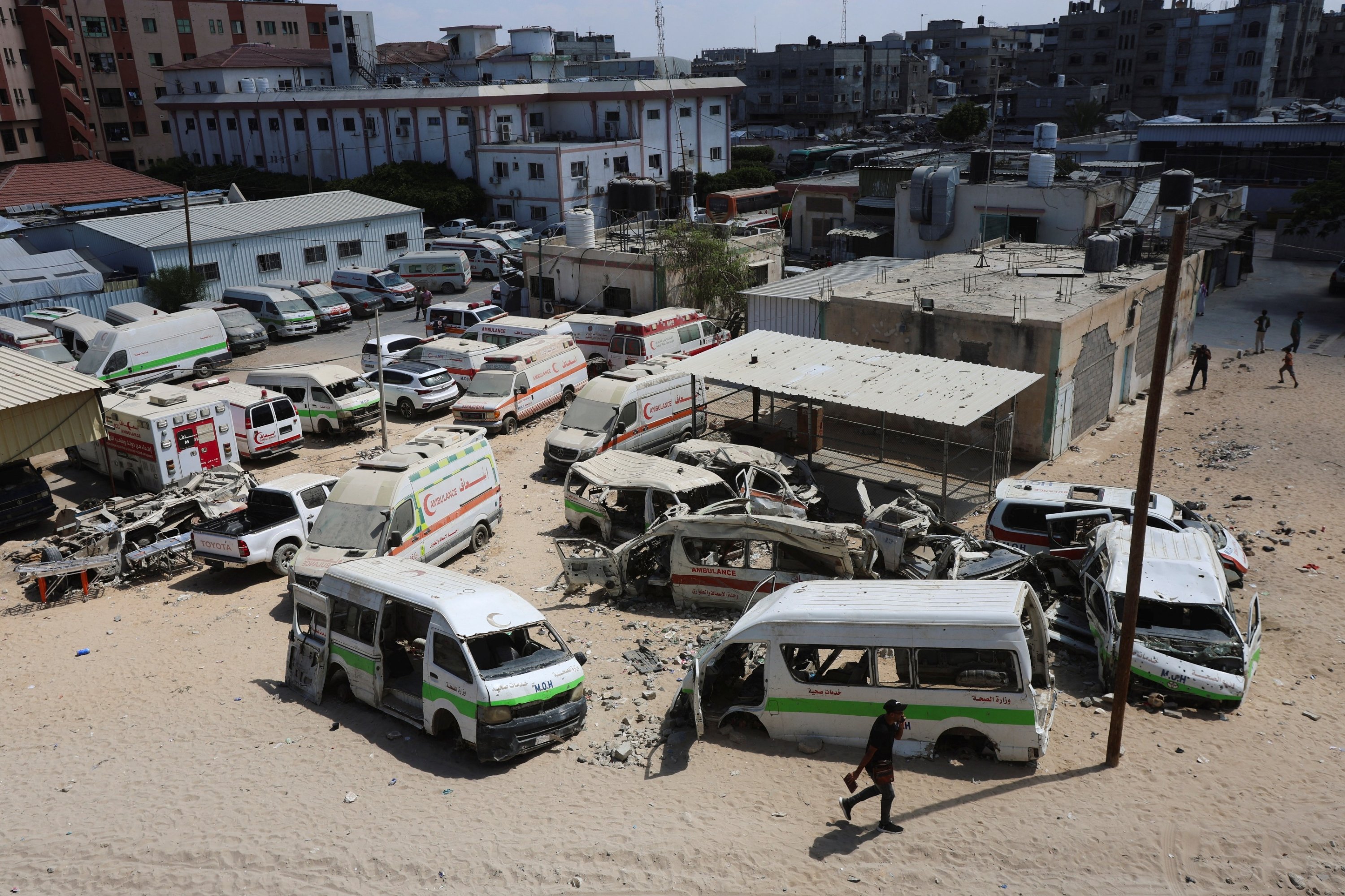
A Palestinian man walks near damaged ambulances and vehicles, amid shortages of fuel and oil needed to run the generators, at Nasser Hospital in Khan Younis, in the southern Gaza Strip, Sept., 2026. (Photo by Reuters)
President Recep Tayyip Erdoğan said lasting peace in the Middle East would remain out of reach without an end to the Israeli bloodshed in Gaza, a permanent cease-fire and a dignified future for Palestinians on their own land, as he outlined Türkiye's positions on regional conflicts, ties with the United States and a series of global challenges following the U.N. General Assembly.
Speaking to journalists at the Türkevi Center in New York, Erdoğan addressed Gaza peace efforts, Türkiye-U.S. relations and the F-35 program, tensions involving Iran and the Strait of Hormuz, the Russia-Ukraine war and Black Sea security, the Mecca Defense Agreement, the "terror-free Türkiye" initiative, relations with Iraq and Greece, U.N. reform and the COP31 climate summit Türkiye will host in Antalya.
"Without stopping the bloodshed in Gaza, making the cease-fire permanent and ensuring that Palestinians have a dignified future on their own land, lasting peace will not come to the Middle East," Erdoğan said.
He said the political will that emerged under the Gaza peace plan was significant, arguing that nearly all parties, including Hamas, had taken positive steps and demonstrated their willingness to reach a solution.
Erdoğan slammed Israel for continuing its attacks and undermining peace efforts, saying the international community, particularly the United States, should make clear that Israel must comply with the plan.
Simply calling for the war in Gaza to stop was not enough, the president said, stressing that mechanisms were needed to prevent fighting from restarting, accelerate Gaza's reconstruction and secure the Palestinians' political future.
Erdoğan also highlighted the continuing humanitarian crisis, saying people had been struggling to survive among the rubble for years, amid Israel's unlawful blockade.
"This is a matter that concerns the common conscience of humanity," he said.
Türkiye-US ties, F-35s and defense
Erdoğan also addressed Türkiye's effort to return to the F-35 fighter jet program, saying he had discussed the matter with U.S. President Donald Trump during a NATO meeting.
He said Trump had demonstrated a positive stance toward Türkiye's return to the program and that Ankara now expected that position to be translated into concrete action.
"We expect this will to turn into concrete steps," Erdoğan said, adding that contacts with Washington were continuing. "I believe we will get results."
Erdoğan said his relationship with Trump had also given momentum to Türkiye-U.S. relations, arguing that cooperation between the NATO allies had advanced considerably compared with the previous U.S. administration.
He stressed, however, that Türkiye's domestic defense industry remained a major priority.
Erdoğan pointed to the domestically developed KAAN fighter jet, Türkiye's air defense systems and other defense capabilities, saying Ankara wanted to produce its own systems while simultaneously pursuing cooperation with its allies.
He also said talks with Britain over the Eurofighter Typhoon were continuing.
"Türkiye has security, defense needs and strategic objectives," Erdoğan said, adding that Ankara would continue working toward those goals without stepping back.
Iran and Strait of Hormuz
On tensions involving Iran and the U.S., Erdoğan said developments in the Strait of Hormuz demonstrated that the crisis was no longer merely an issue between Tehran and Washington.
Türkiye opposed closing the strait to maritime traffic and considered maintaining freedom of navigation essential, he said.
The president warned that every escalation in Hormuz affected not only regional countries but also Europe, Asia, energy markets, transportation and the daily lives of millions of people.
He pointed to a sharp decline in commercial shipping traffic as evidence of the wider impact and described the strait as vital to global energy security and international trade.
Erdoğan said reopening Hormuz was important for resolving disputes through dialogue and negotiations and that Türkiye was urging all parties to return to the negotiating table.
"What needs to be opened are not new fronts, but new channels of diplomacy," he said.
Ukraine, Black Sea security
Turning to the Russia-Ukraine war, Erdoğan said the Black Sea should not become another front in the conflict and called for the restoration of maritime security.
He said ensuring safe navigation would both protect food security and help prevent the war from spreading.
Türkiye opposed attacks on commercial vessels regardless of who carried them out, Erdoğan said, calling on the parties to act responsibly.
He also announced that Ankara was intensifying efforts to restore the Black Sea grain corridor and accelerating diplomatic contacts toward that goal.
Erdoğan said he raised the issue again with Ukrainian President Volodymyr Zelenskyy during their meeting in New York and received a positive response.
Mecca Defense Agreement
Describing the Mecca Defense Agreement as a strong step in the right direction, President Erdoğan said challenges facing the initiative at an early stage were not unexpected.
He said Türkiye was an experienced state that would not be drawn into provocations or traps and expressed confidence that the initiative would become stronger as its institutional structure was completed.
Erdoğan said the agreement had laid the foundations for a framework capable of producing regional solutions to regional problems.
He argued that outside powers that had attempted to prescribe security solutions for the region had often left greater instability behind.
The initiative, he said, was like a newly planted sapling that would eventually grow into a large tree.