History of the Kaaba Door
History of the Kaaba Door
The Kaaba is the most sacred and revered site in Islam. For the world’s 1.8 billion Muslims, it serves as the focal point of their faith, worship, and pilgrimage. All Muslims face toward it—the Qiblah—during their daily prayers, and they circumambulate it in the ritual of Tawaf, a practice rooted in antiquity.
Located at the center of Masjid al-Haram in Makkah, the Kaaba is mentioned in the Noble Quran by several names, including Bait-ul-Ateeq (the Ancient House), Bait-ul-Haram (the Sacred House), and Bait-ul-Allah (the House of Allah). It is regarded as the first place of worship established on Earth, originally built by Prophet Adam (peace be upon him). Approximately 5,000 years ago, Prophet Ibrahim (peace be upon him) and his son Prophet Ismail (peace be upon him) rebuilt it on the same foundations, resulting in the structure that stands today.
The Quran highlights its significance in several verses, including:
“Verily, the first House (of worship) appointed for mankind was that at Bakkah (Makkah), full of blessing and a guidance for the Alameen (mankind and jinn).” (Surah Al-Imran, Verse 96)
“And (remember) when We showed Ibrahim the site of the Sacred House (the Kaaba at Makkah).” (Surah Al-Hajj, Verse 26)
“And circumambulate the Ancient House (Kaaba at Makkah).” (Surah Al-Hajj, Verse 29; note: often referenced in connection with Al-Imran as well)
These verses affirm the Kaaba’s ancient sanctity. Even before the advent of Islam, the people of the Arabian Peninsula revered it as an exceptionally holy site.
In Islam, the Kaaba is considered one of the greatest Sha’a’ir Allah (Symbols of Allah). Honoring these symbols is an act of piety, as the Quran states: “And whosoever honours the Symbols of Allah, then it is truly from the piety of the hearts.” (Surah Al-Imran, Verse 32)
Throughout history, natural disasters (such as floods) and human events have necessitated multiple renovations and rebuilds of the Kaaba, bringing it to its present form. Kings and rulers across eras have taken great care in maintaining it—providing the Kiswa (its covering), rebuilding parts or all of it, and crafting its elements, from the golden waterspout to the ornate door on its eastern wall.
Caring for the Kaaba’s door has always been an immense honor. Rulers ensured that only the finest craftsmen, designers, and calligraphers worked on it. In the modern Saudi era, for example, the previous and current doors were crafted by the renowned Makkah goldsmith family: Sheikh Ibrahim Badr and, later, his son Sheikh Ahmad bin Ibrahim Badr along with relatives. The current door was designed by the acclaimed Syrian engineer Muneer Sarri Al-Jundi, who passed away in December 2020.
While the oldest surviving and precisely datable Kaaba door dates to the Ottoman era of Sultan Murad IV, historical texts indicate that at least three earlier doors existed before it.
Early Doors and Traditions
Islamic tradition holds that Prophet Ibrahim (peace be upon him) built the Kaaba as a simple rectangular structure without a door or roof, featuring an entry portal on the eastern wall and an exit on the western wall. The Black Stone (Hajar al-Aswad) was embedded in one corner. Over centuries, ruling tribes in Makkah rebuilt it multiple times.
According to historian Ibn Hisham (d. 833 CE) and Al-Azraqi (d. 837 CE) in his Kitab Akhbar Makkah, the first known door was installed by King Tubba of Yemen (d. ca. 430 CE), a convert to Judaism who visited Makkah before the birth of Prophet Muhammad (peace be upon him). Tubba reportedly covered the Kaaba, instructed the Jurhum tribe to maintain its cleanliness, and ordered a door with a key. This wooden door remained in use through the pre-Islamic and early Islamic periods.
In 608 CE, the Quraysh tribe rebuilt the Kaaba after flood damage. Due to limited funds, they shortened it slightly, adding the low semicircular wall (Hateem) and raising the eastern door high above ground level while sealing the western exit—transforming it from oblong to more cubical.
In 683 CE (64 AH), Caliph Abdullah ibn al-Zubayr (may Allah be pleased with him) restored the original Ibrahimic dimensions, lowering the door to ground level and reopening the western exit. After the Umayyad reconquest in 692 CE (73 AH), it was rebuilt to the Quraysh dimensions, with the door raised again and the western portal sealed. Remnants of this “hidden door” are believed to be preserved in some museums.
Ottoman Era Door (Sultan Murad IV)
The oldest known datable door was installed during Ottoman Sultan Murad IV’s reign. After heavy rains in 1630 CE damaged the Kaaba (collapsing its eastern and western walls), Egyptian craftsmen began work in 1629 CE (1039 AH) and completed it in 1630 CE (1040 AH), with installation around 1634 CE (1045 AH).
Divided into two panels, it featured geometric designs plated with 166 pounds of silver, coated in gold leaf and durable metal sheets. This was the first door to combine silver and gold prominently. It endured over 300 years until 1947.
This historic door is now part of exhibitions, including the Roads to Arabia display (loaned by Riyadh’s National Museum) at the Louvre Abu Dhabi.
King Abdulaziz Al Saud’s Reign
In 1944, King Abdulaziz bin Abdul Rahman Al Saud, founder of modern Saudi Arabia, ordered a new door after learning the old one was deteriorating. Crafted at his expense, it featured an aluminum frame reinforced with iron bars, covered in gold-plated silver plates, and inscribed with Allah’s attributes. It included a metal base with two wooden shutters of Javanese teak and retained a lock from 1891.
Renowned Makkah goldsmith Sheikh Ibrahim Badr led the work, which took three years. Installed on October 31, 1947, it served for about 30 years and is now displayed at the Exhibition of the Two Holy Mosques Architecture in Makkah.
The Current Kaaba Door
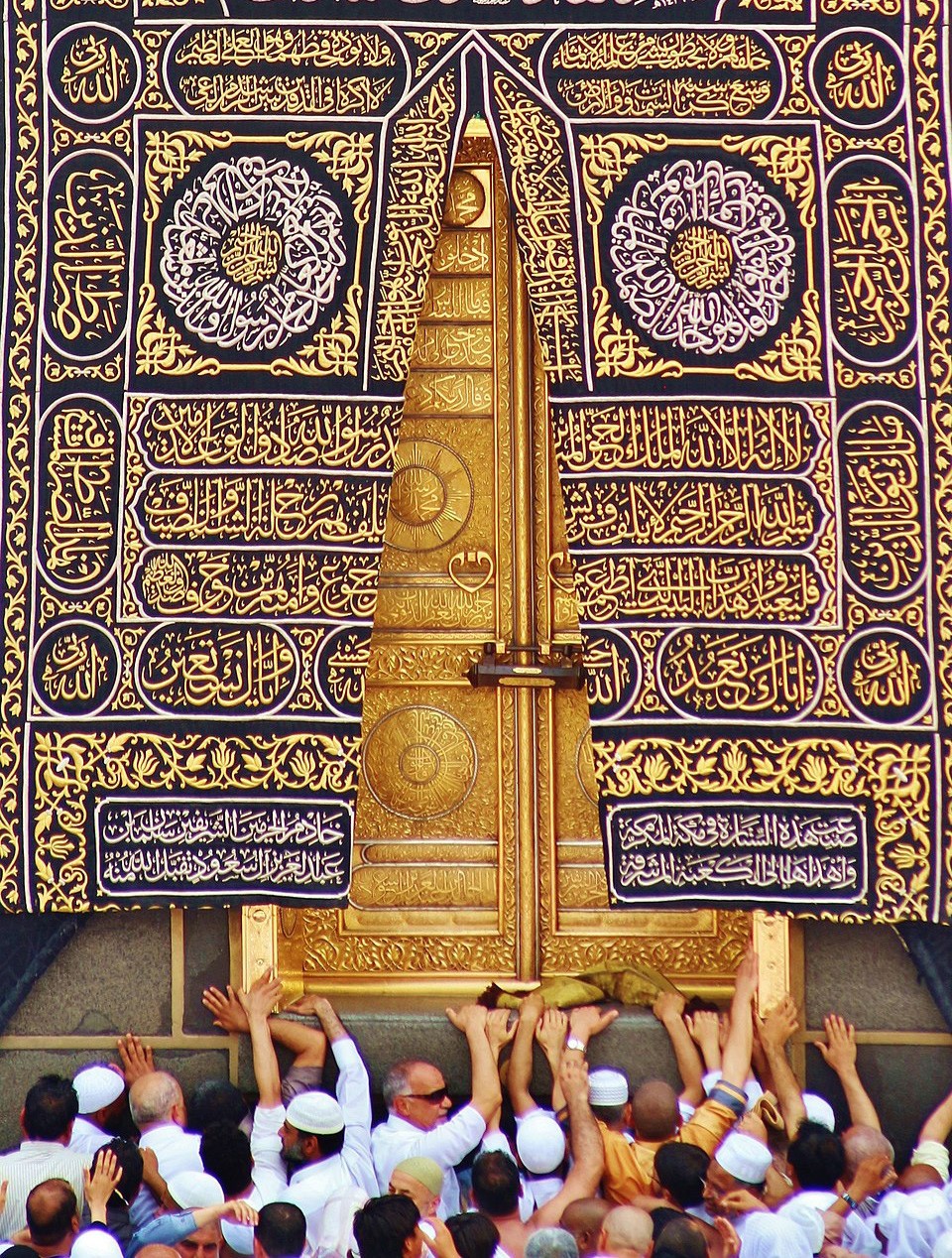
The present door was installed on October 13, 1979, during the reign of King Khalid bin Abdulaziz Al Saud. In 1976–1977, while praying inside the Kaaba, King Khalid noticed scratches and wear on the existing door. He commissioned a new one made of pure gold and also ordered a rooftop access door (Bab al-Tawbah) on the northern side.
The Badr family—led by Sheikh Ahmad bin Ibrahim Badr, with relatives Mahmoud and Ibrahim Badr—crafted it in a dedicated workshop. Engineer Muneer Sarri Al-Jundi designed it.
Measuring 3 meters high, 2 meters wide, and 0.5 meters deep, the door uses 2.5 cm-thick aluminum coated with gold-dipped silver plates. Its base is made of rare Maca Moong wood from Thailand. It incorporates over 280 kg of pure gold—one of the largest single uses of gold in the world—and is adorned with 15 of Allah’s 99 Names in Thuluth calligraphy, plus circular panels with Quranic verses, Islamic phrases, and historical notes.
Key Quranic inscriptions include:
“In the name of Allah, the Most Compassionate, the Most Merciful.”
“Enter therein in peace and security.” (Surah Al-Hijr, Verse 46)
“Allah has made the Kaaba, the Sacred House, an asylum of security and benefits for mankind...” (Surah Al-Ma’idah, Verse 97)
“And say: ‘My Lord! Let my entry be good and my exit be good. And grant me from You an authority to help me.’“ (Surah Al-Isra, Verse 80)
“...Your Lord has written (prescribed) Mercy for Himself...” (Surah Al-An’am, Verse 54)
“And your Lord said: ‘Invoke Me, I will respond to your (invocation)...’“ (Surah Ghafir, Verse 60)
“Say: ‘O My slaves who have transgressed against themselves! Despair not of the Mercy of Allah; verily Allah forgives all sins. Truly He is Oft-Forgiving, Most Merciful!’“ (Surah Al-Zumar, Verse 53)
In Islam, the Kaaba’s door holds no independent religious significance beyond its role as part of the sacred structure. Its magnificence reflects the glory and sanctity of the House of Allah, the Kaaba itself. Each door in its history carries a rich legacy of devotion and craftsmanship.