Hidden Muslim Legacy in the Americas
Hidden Muslim Legacy in the Americas
When eight centuries of Muslim rule in Al-Andalus (Muslim Spain) came to an end in 1492, Islam found new expression in the West Indies through Andalusian Muslim mariners who guided Columbus’s voyages across the Atlantic.
Trained for centuries in Atlantic navigation, these mariners were not merely pilots; many sought religious freedom and peace as they left behind a devastated Al-Andalus. On Columbus’s second voyage in 1494, they set foot on the island of Jamaica — a land of wooded mountains, waterfalls, sandy beaches, and crystal-blue seas. Although unknown to Columbus and his Christian companions, these Arabic-speaking Muslim mariners were already familiar with the region, its islands, and its people.
The name “Carib” — the root of “Caribbean” — is a Qur’anic Arabic word. In Arabic, it is spelled Qareeb (قريب), meaning “near,” “nearby,” “close,” “neighbor,” or “relative.” The plural/adjectival form Qareebun (قريبون) corresponds to “Caribbean” or “Cariban.” These terms have been part of the Arabic language for nearly three thousand years and appear frequently in the Holy Qur’an, often as an attribute of Allah — Al-Qareeb, The Near.
This etymology predates Columbus by centuries. The earliest recorded European use of “Carib” and “Caribbean” only appears in the mid-1500s, often linked to the derogatory association with cannibalism. In contrast, in Arabic, Qareeb and Qareebun have long conveyed positive meanings of closeness, neighborliness, and human connection.
Well-versed in Arabic and experienced in Atlantic voyaging, the Andalusian Muslim mariners are believed to have named the western part of the North Atlantic — bounded by Central America, northern South America, and the nearby islands — the Qareebun (Caribbean) region, and its inhabitants the Qareeb (Caribs), long before Columbus’s arrival. Historical accounts, such as that of the 10th-century historian Ali Al-Masudi in The Meadows of Gold, record that Muslim mariners from Al-Andalus, led by Khashkhash Ibn Said Ibn Aswad, sailed into the Atlantic in 889 CE and returned with treasures. Similar pre-Columbian transoceanic voyages are attributed to other navigators, including China’s Admiral Zheng He.
The Islamic presence in the region continued through the arrival of enslaved West African Muslims, who were brought to work on Jamaican plantations. Many resisted slavery through flight — a form of hijra — and established independent Maroon communities (ummah). Though isolation and suppression later weakened open Islamic practice, these communities preserved elements of their faith and heritage.
This linguistic and historical evidence calls for a serious re-examination of the historiography of the Americas, recognizing the significant but often overlooked contribution of Muslim mariners and African Muslims to the region’s early story.
Notes / References
[1] The terms “Carib” and “Caribbean” correspond to the Arabic Qareeb and Qareebun.
[2] See accounts in Ali Al-Masudi’s The Meadows of Gold (947 CE). [3] Sultana Afroz, Invisible Yet Invincible: The Islamic Heritage of the Maroons and the Enslaved Africans in Jamaica (London: Austin & Macauley, 2012), pp. 68–72. [4] Richard Price (ed.), Maroon Societies: Rebel Slave Communities in the Americas (Baltimore & London: Johns Hopkins University Press, 1996).
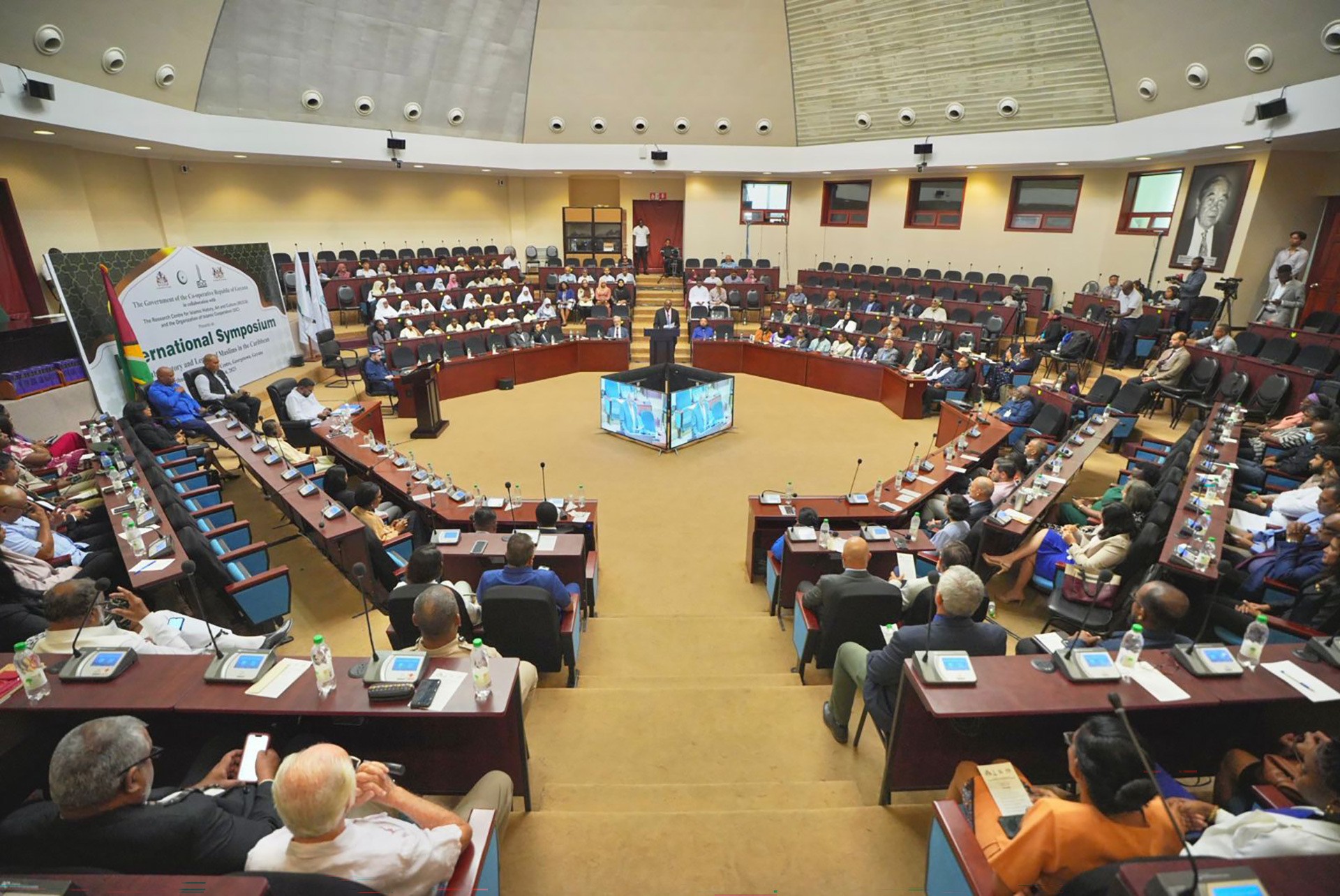
Abridged from “The Muslim Maroons in the Carib Neighbourhood of Jamaica,” in History and Legacy of the Muslims in the Caribbean, IRCICA, Istanbul, 2025, pp. 79–112.
The Spanish/English terms Carib and Caribbean in Arabic are spelt as Qareeb and Qareebun. The Holy Qur’an reads: “Wa izaa sa-alaka ‘ibaadee ‘annee fa-innee qareebun ujeebu da ‘wataddaa ‘I izza da’aani falyastajeeboo lee walyu ‘minoo bee la ‘allahum yarshudoon, meaning “When My servants ask you (meaning the Prophet) concerning Me, I am indeed close/qareebun to them: I listen to the prayer of every suppliant when he calls on Me: let them also with a will, listen to My call, and believe in Me: that they may walk in the right way” (The Holy Qur’an, Surah Al-Baqarah, 2:186) and also Surah Baqarah verse 2:214 refers to Qareeb as near. The Holy Qur’an is laced with the word Carib and Caribbeen. In Surah Saba, the word carib/qareeb denotes near as the verse states: “wa inih-ta-daytu fabimaa yoobee ilaayya Rabbee; innahoo Samee’un Qareeb”, (…but if I receive guidance, it is because of the inspiration of my Lord to me: it is He Who hears all things, and is ever near, Surah Saba, 34:50). Also see Surah Nisa, 4:77; Surah Hud, 11:61 & 11:81; Surah Saba, 34:51; Surah Ash-Shura, 42:17; Surah Hashr, 59:15.