Gold, paper currency and riba: Understanding the difference
Dhaka
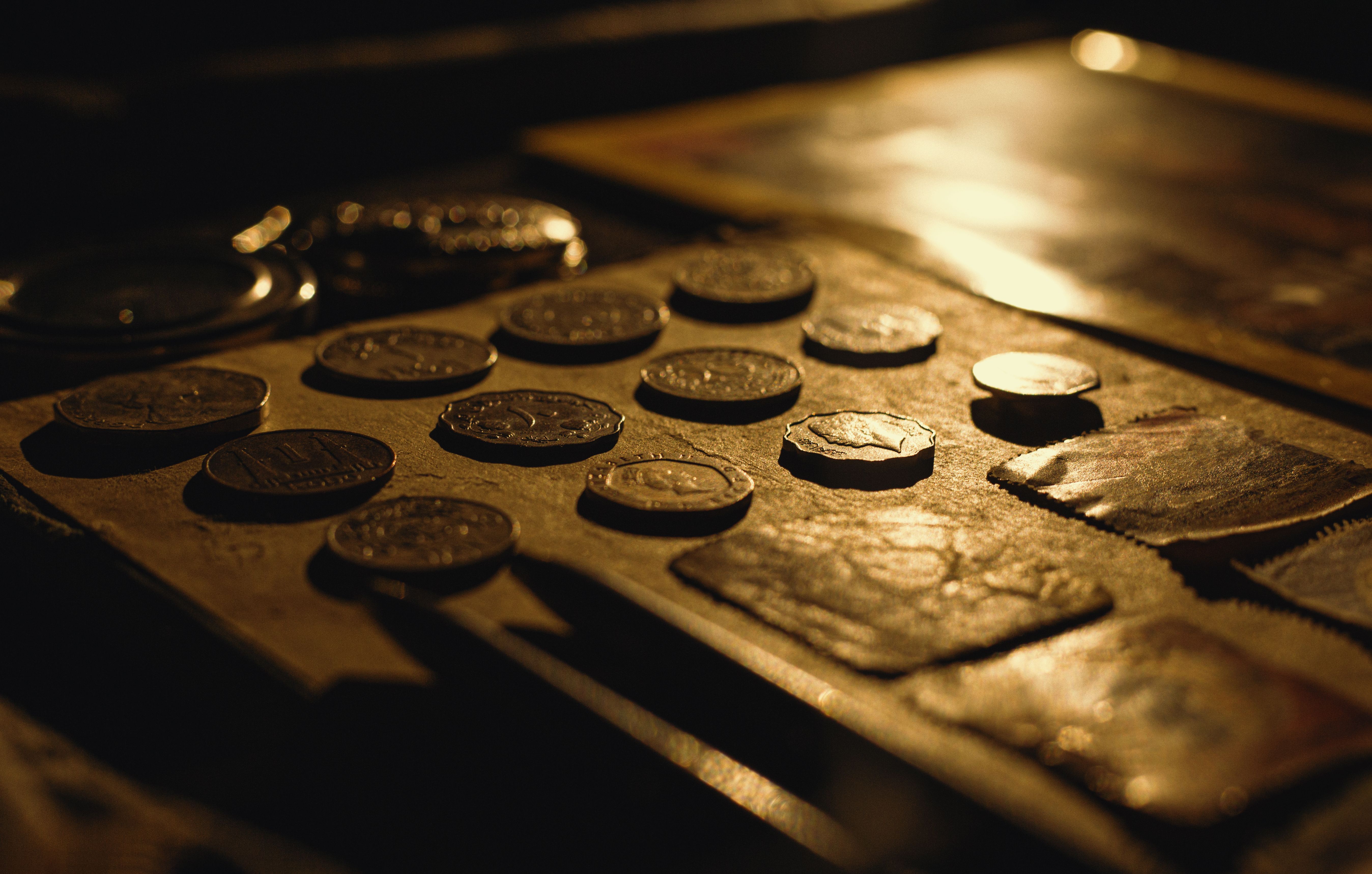
Close-up of antique coins on a table, captured with dramatic lighting and rich textures. (Photo by Pexels)
The history of money began with the barter system, in which goods were exchanged for other goods. Later, measured pieces of precious metals such as gold and silver came into use, as exemplified by the Lydian Lion coins. This was followed by metal coins bearing royal symbols and recognized by governments. Eventually, modern paper currency and digital transaction systems emerged alongside economic development. Today, the taka is the official currency of Bangladesh.
Regarding riba (interest or usury), Allah says: “Those who consume interest will not stand except as one stands who is being beaten by Satan into insanity. That is because they say, ‘Trade is just like interest.’ But Allah has permitted trade and has forbidden interest. So whoever has received an admonition from his Lord and desists may have what is past, and his affair rests with Allah. But whoever returns to it — those are the companions of the Fire; they will abide therein eternally.” (Qur’an 2:275)
Riba is a commonly used Arabic term. Some interpret it as interest, meaning an additional amount charged in return for lending money, while others interpret it more broadly as economic injustice — that is, any form of economic wrongdoing. For example, denying workers fair wages or taking someone else’s money through manipulation or fraud in the stock market could also be considered forms of economic injustice.
History shows that during the early Islamic period, silver dirhams — coins associated with the Persian-Sasanian Empire — and gold dinars — coins associated with the Roman-Byzantine Empire — were in circulation. Later, Caliph Abd al-Malik ibn Marwan introduced fully Islamic gold dinars and silver dirhams. Images of people were removed, while Arabic inscriptions, Qur’anic verses and the phrase “La ilaha illallah” were inscribed on the coins.
It is worth noting that gold dinars and silver dirhams had certain distinctive characteristics that paper currencies do not have. First, they possessed intrinsic value; the coins themselves were valuable because they were made of gold or silver. Second, gold coins had two kinds of value: value in use and value in exchange. Third, even if a government discontinued or invalidated gold coins as legal currency, they would not necessarily lose their underlying value.
The characteristics of paper currency, or fiat money, are different. First, paper currency has little or no intrinsic value. Second, its value is maintained through the government’s credibility and its status as legal tender. In other words, it works because the government declares that the note can be used to buy and sell goods and services, and people accept it on that basis. Third, paper currency may be viewed as a substitute for a monetary asset, but it is not the same as actual gold or silver. Fourth, if a government withdraws a paper currency from circulation, its usefulness as money may disappear, leaving the paper with little practical value.
The question, then, is this: Against what are the taka and the U.S. dollar issued?
Until 1971, the U.S. dollar was convertible into gold under the international monetary system then in place. In such a system, a unit of currency represented a specified quantity of gold. In 1971, U.S. President Richard Nixon ended the dollar’s convertibility into gold. Today, neither the taka nor the US dollar is issued against a fixed quantity of gold. Modern fiat currencies derive their value from government backing, monetary institutions, economic capacity, and confidence in both the currency and the issuing state. This is known as the fiat money system — money created under government authority.
During the COVID-19 pandemic, monetary expansion followed another process. In 2020, governments and central banks around the world — particularly in the United States and Europe — introduced extensive monetary and liquidity-support measures, including quantitative easing (QE). New money was largely created electronically and added to the financial system rather than being issued against a corresponding quantity of gold or other physical assets. These measures provided economic relief, although inflation later increased in many countries. In this sense, the money created during the pandemic represented a significant expansion of fiat money.
The main point of the discussion above is that gold and silver coins are fundamentally different from paper currency. Because gold has practical and intrinsic value, it continues to be bought and sold in the market even when it is no longer used as official currency.
We can also observe that the price of gold has generally increased over the years, while the purchasing power of paper currencies tends to decline when measured against gold or other goods and commodities. In other words, when gold is used as the reference point, an inverse relationship may be seen between the price of gold and the value of paper currency: as the price of gold rises in paper-currency terms, the purchasing power of that currency declines.
Let us consider what happens in practice.
It may be argued that an increase in the quantity of gold represents an additional amount, or interest, whereas an ordinary increase in the amount of paper money does not necessarily constitute interest in the same sense. However, according to this argument, if an amount greater than the increase in the price of gold is paid, the excess beyond that increase would constitute interest.
In other words, what is considered interest in transactions involving gold currency is not necessarily considered interest in the same way in transactions involving paper currency.
If this distinction is not properly understood, a person may unintentionally become involved in interest and suffer its consequences.