BRICS Summit 2026: Growing influence, divided interests
Jeddah
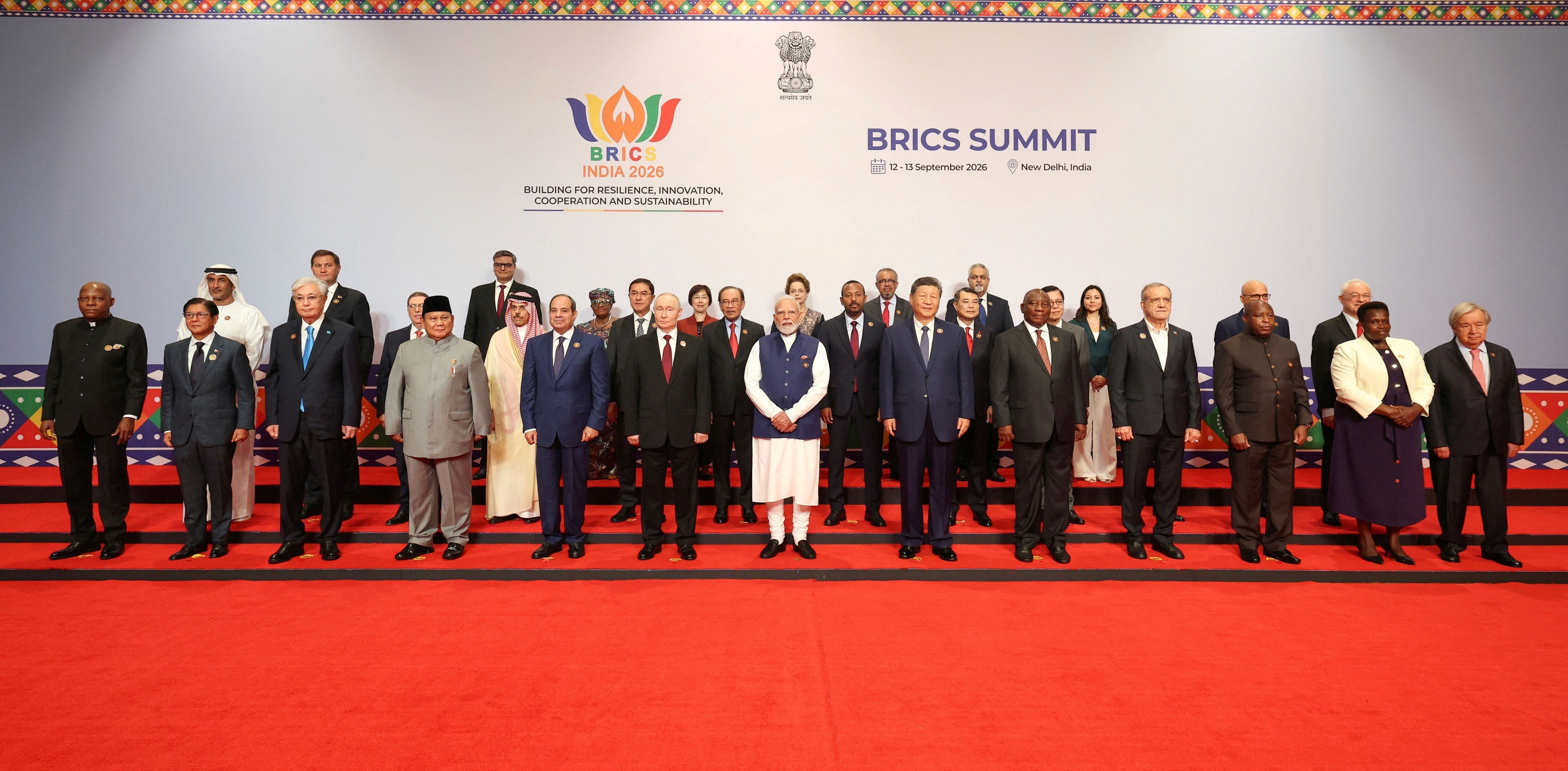
BRICS leaders pose for a family photograph on day two of the BRICS Summit in New Delhi, India, Sept. 13, 2026. (Photo by AFP)
The 18th BRICS Summit, held in New Delhi on September 12, 2026, gave a clarion call for an international order with better representation, more financial autonomy for emerging economies and greater cooperation on international security.
The unanimously adopted New Delhi Declaration addressed issues ranging from United Nations reform and international trade to terrorism, AI and conflicts in the Middle East.
Representing roughly half the world's population, the bloc has gained momentum, becoming an important platform capable of making an impact on much of the globe. Together, the BRICS nations comprise at least 40% of global GDP and 26% of international trade, a fact that gives leverage to countries seeking a greater voice in global governance. Its expanding economic weight, however, has not automatically translated into political unity.
However, questions were once again raised about whether BRICS would stand together, given that its member states do not always share the same geopolitical interests. Yet, the bloc is expanding despite facing challenges.
Push for a balanced world order
Reform of international institutions featured prominently in the declaration. BRICS reiterated its support for a greater role for Brazil and India in the United Nations, including the Security Council, while acknowledging the positions of China and Russia as permanent members.
The bloc also demanded reforms of the International Monetary Fund and World Bank to give emerging and developing economies voting power that better reflects their economic standing. It urged the implementation of the IMF's 16th General Review of Quotas without further delay.
On trade, the leaders called for restoring the World Trade Organization's fully functioning dispute settlement mechanism and opposed unilateral sanctions and carbon border adjustment measures.
These demands reflect a broader concern among emerging economies that existing international institutions have not adequately adapted to changes in the global economic landscape.
Financial independence
One of the summit's closely watched issues was reducing dependence on the US dollar in international transactions. Rather than committing to a common BRICS currency, the declaration encouraged greater use of national currencies in trade settlements and investments. It tasked the BRICS Payment Task Force with advancing cooperation on cross-border payment systems.
The declaration acknowledged that there was no universal approach suitable for every member, reflecting differences over the pace and extent of financial integration.
Conflicts in the Middle East
The summit expressed deep concern over escalating tensions in West Asia, urging maximum restraint and the protection of civilians, nuclear facilities and critical infrastructure.
On Palestine, BRICS voiced concern over continuing violence in Gaza despite the October 2025 ceasefire agreement. It opposed the forced displacement of Palestinians and reaffirmed support for Palestinian membership in the United Nations and a two-state solution based on the 1967 borders, with East Jerusalem as Palestine's capital.
The declaration also strongly condemned the April 2025 Pahalgam terrorist attack in India, which killed 26 people. It called for zero tolerance toward terrorism, stronger action against terrorist financing and safe havens, and international cooperation without double standards.
Other regional issues received attention, including the conflicts in Sudan and Syria and the situation in Lebanon. Notably, however, the declaration avoided mentioning the Russia-Ukraine war by name, illustrating the difficulty of securing consensus on politically sensitive questions.
AI and energy security
Artificial intelligence emerged as an important area of cooperation, with leaders committing to advance global AI governance alongside cybersecurity and measures against cross-border digital crime.
Energy security was another major priority. The declaration emphasized stable energy markets, uninterrupted supplies and the protection of critical infrastructure. It also called for fair and resilient supply chains for critical minerals while respecting resource-rich countries' sovereignty.
Challenges ahead
The New Delhi summit demonstrated BRICS' growing ambition to reshape global economic governance and strengthen cooperation among emerging powers. Nevertheless, its carefully negotiated language on contentious international issues highlighted the limitations of consensus among countries with differing strategic priorities.
As China prepares to assume the bloc's chairship in 2027, the central question is whether BRICS can translate its expanding economic influence and ambitious declarations into coordinated action and meaningful institutional reforms.
Its future significance will depend not merely on the size of its membership or its collective economic strength, but on its ability to turn shared aspirations into practical results.