Under the leadership of Mohammad Zakir Hossain, Chairman of Al-Ummah Foundation and Editor-in-Chief of Al-Ummah Journal, the Foundation has intensified a series of high-profile intellectual, educational, and humanitarian engagements, aimed at strengthening Islamic scholarship, promoting Muslim unity, and amplifying global awareness regarding the Palestinian cause.
Currently visiting Bangladesh, Zakir Hossain engaged in activities that demonstrated the expanding role of Al-Ummah Foundation as a platform for:
Islamic intellectual development
Educational and research initiatives
Media and publication work
International scholarly cooperation
Advocacy for Palestine and Jerusalem
Promotion of Muslim unity and strategic awareness
Growing Role of Al-Ummah Foundation
Mr. Hossain held several academic and intellectual platforms across Dhaka, bringing together prominent scholars, journalists, researchers, educators, and social thinkers from Bangladesh, Palestine, and Turkey. The initiatives, according to observers, reflect a growing effort to foster informed dialogue, intellectual cooperation, and moral solidarity within the global Muslim Ummah amid ongoing geopolitical and humanitarian crises.
Through seminars, publications, international partnerships, academic lectures, and public engagement programs, the organization continues to contribute to informed discourse and humanitarian consciousness on issues affecting the global Muslim community.
Observers note that in a rapidly evolving geopolitical environment marked by conflict, polarization, and information warfare, initiatives grounded in scholarship, ethical media engagement, and intercultural dialogue are becoming increasingly important for promoting awareness, unity, and constructive social development within the Muslim world.
Foundation Chief Meets Dr. A.F.M. Khalid Hossain
One of the most notable engagements was a courtesy meeting between Foundation chief Zakir Hossain and Dr. A.F.M. Khalid Hossain, the former Religious Affairs Advisor to Bangladesh’s Interim Government.
During the meeting, Zakir presented a copy of the inaugural Bengali edition of Al Ummah Journal, a newly launched intellectual and research-oriented publication that aims at promoting Islamic scholarship, social awareness, and contemporary discourse among Bengali-speaking Muslims worldwide.
Dr. Khalid Hossain, also a contributor to its first issue, praised the initiative and highlighted the importance of responsible Islamic journalism and intellectual engagement in the modern era. Discussions focused on the journal’s editorial vision, long-term objectives, and plans for expanding its digital and international outreach.
Both sides emphasized the urgent necessity of establishing credible and principled media platforms capable of addressing misinformation, ideological fragmentation, and cultural disorientation affecting contemporary Muslim societies.
Other participants at the meeting hoped the Journal would evolve into a respected platform for knowledge dissemination, critical thought, and constructive dialogue across the Muslim world.
Palestine Event Draws Wide Response
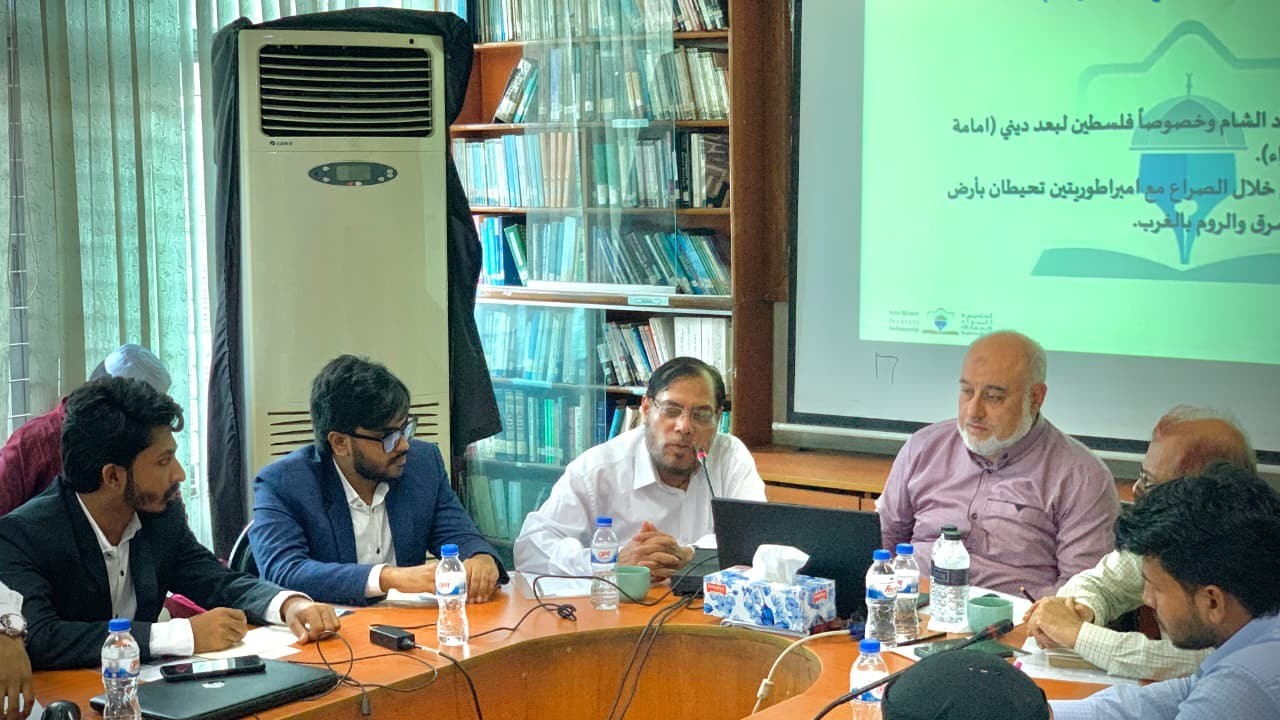
As part of its broader educational and humanitarian mission, Al-Ummah Foundation collaborated with the Bangladesh Institute of Islamic Thought (BIIT), Al-Ruwwad Academy for Jerusalem Studies, and Bangladesh Masjid Mission to organize a major academic lecture series titled: “17 Hours’ Lecture on History & Issues of Palestine.”
The three-day educational event was held from 20–22 May 2026 at the BIIT Training Room in Uttara, Dhaka. The sessions were conducted by distinguished Palestinian scholar and academic expert, Engineer Adnan Alhajshaker, Director, Al-Ruwwad Academy for Jerusalem Studies, Istanbul.
The lecture series explored multiple dimensions of the Palestinian issue, including:
Historical evolution of Palestine and Jerusalem
Political and legal dimensions of the conflict
Israeli occupation and humanitarian challenges
International geopolitics and Middle East dynamics
Media narratives and global power structures
Responsibilities of Muslim societies toward Palestine
The event attracted students, academics, researchers, journalists, social activists, and members of civil society seeking a deeper understanding of the historical and contemporary realities surrounding Palestine.
Organizers described the initiative as part of an ongoing intellectual effort to cultivate informed discourse, strengthen historical awareness, and encourage moral and humanitarian solidarity with the Palestinian people. Participants received certificates, educational resources, and opportunities for scholarly engagement and discussion throughout the program.
Seminar: Palestine as a Civilizational and Moral Question
Another significant intellectual event took place at the BIIT Seminar Hall in Uttara under the title: “Palestine and the Crisis of Modern Civilization.” Held on 22 May 2026, the seminar featured the renowned journalist, researcher, academic, and social organizer, Mir Lutful Kabir Saadi, who addressed the Palestinian issue not merely as a regional political dispute but as a profound moral and civilizational crisis confronting the contemporary international order.
In his keynote lecture, he discussed themes, including “global justice and human rights,” “media representation and political narratives,” “international humanitarian responsibility,” “ethical journalism and intellectual resistance,” and “the erosion of moral consistency in global politics.”
He argued that Palestine has become a defining test of modern civilization’s commitment to justice, human dignity, and universal ethical principles.
While participating in the seminar, Al-Ummah Foundation reaffirmed its continued support for educational advocacy, scholarly engagement, and humanitarian awareness regarding Palestine and Gaza.
Muslim Unity and Geopolitical Challenges
In yet another important engagement in Dhaka, Foundation Chairman Zakir Hossain participated in an exclusive strategic discussion hosted by Mr. Sabbir Uddin Ahmed, an educationist, writer, and intellectual figure. Engineer Adnan Alhajshaker, a Palestinian scholar and Director of Al-Ruwwad Academy for Jerusalem Studies, also attended the meeting, which involved an extensive discussion on the current condition of the Muslim Ummah, focusing particularly on the humanitarian catastrophe unfolding in Palestine, particularly Gaza.
Topics discussed included:
The suffering and displacement of Palestinians
The geopolitical complexities of the Middle East
The influence of Western powers on regional instability
The need for strategic Muslim cooperation and solidarity
Educational, technological, and intellectual collaboration among Muslim-majority countries
The meeting stressed unity to overcome sectarian divisions, including Sunni-Shia polarization, to establish stronger unity and cohesion within the Muslim world. Participants noted that countries such as Turkey, Pakistan, and Saudi Arabia possess the strategic and institutional capacity to play a constructive role in fostering collaborative initiatives in defense, technology, research, education, and humanitarian support for Muslim societies.
The meeting concluded in a cordial atmosphere characterized by intellectual openness, mutual respect, and a shared commitment to strengthening cooperation across the Muslim world.
Zakir Hossain also took the occasion to present copies of his recently published Al-Ummah magazine to Engineer Adnan Alhajshaker. Sabbir Uddin Ahmed also presented several of his authored books that covered themes on “Palestine and resistance literature,” “Turkish politics and leadership,” “The contributions of Turkish President Recep Tayyip Erdoğan,” and “Islamic civilisation and contemporary Muslim thought.”
Special Academic Course on Jerusalem Studies
In cooperation with Al-Ruwwad Academy for Jerusalem Studies in Istanbul, Tanzeem Al-Ummah School in Dhaka organised a specialised academic course on Jerusalem Studies from May 13–15, 2026, at the Tanzeem headquarters in Dhaka.
Jointly presented by Al-Ruwwad Academy Director Adnan Alhajshaker and Al-Ummah Foundation chief Zakir Hossain, the program focused on the historical, religious, geopolitical, and cultural significance of Jerusalem and aimed to provide participants with a deeper academic understanding of the city’s role within Islamic civilization and contemporary global politics.
Organizers described the initiative as an important step toward strengthening academic cooperation between Bangladeshi and Turkish institutions while promoting scholarly awareness regarding Jerusalem and Palestine among younger generations.