A World in Crisis Palestine, Polycrisis, and the Collapse of the Moral Order
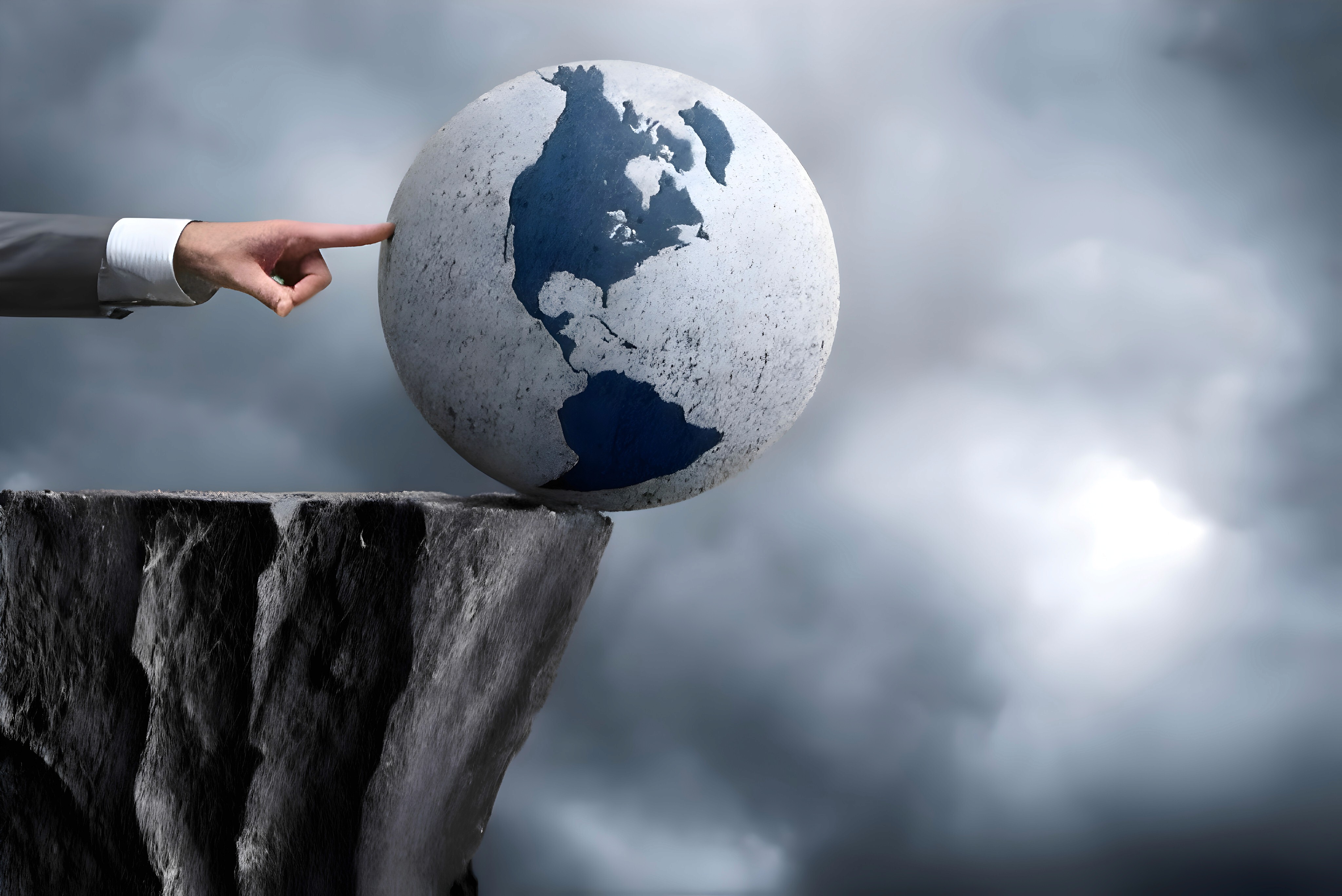
A World in Crisis Palestine, Polycrisis, and the Collapse of the Moral Order
We have just witnessed a live genocide in Palestine — arguably the first and most documented genocide of the 21st century. This slaughter did not merely question the credibility of international institutions. It exposed the moral depravity of world leaders, stunned global conscience, and dragged humanity back to the most fundamental question we have failed to answer for generations: how should the world actually be run?
What is still unfolding in Palestine is not an anomaly. It is the brutal unmasking of the cruelty the world is already enduring. It has ripped away the thin veneer to reveal a cascade of crises now stalking our planet: endless wars, violent geopolitical shifts, accelerating climate collapse, economic decay, collapsing governance, forced migrations, and relentless technological disruption — all feeding into a deepening global permacrisis. As International Rescue Committee President David Miliband has warned, we have entered “a new world disorder” — one that has laid bare the terrifying inability of today’s leaders to govern even their own people, let alone lead humanity.
Just one example says it all: no less than 240 million people globally require assistance as the humanitarian crisis takes its toll. But first Gaza, as this continues slipping into an abyss of dark silence that exposes wider global cruelty—a revelation of how increasingly disposable human suffering has become in contemporary geopolitics.”
Gaza/Palestine
What is happening in Palestine is a defining metaphor for a world sliding into systemic disorder. The tragedy here stands as perhaps the most visible indictment of the paralysis and moral fragmentation of the contemporary international order.
This is not just that the world has simply failed to stop the war. It is the exposure of a deeper civilizational malady: the weakening of universal principles in favor of selective morality, geopolitical expediency, and transactional power politics. The destruction in Gaza has revealed the extent to which the post-1945 liberal order, once built upon promises of human rights, international law, and collective security, is losing legitimacy in the eyes of much of humanity.
The ongoing civilizational dysfunction has sharpened perceptions of a glaring double standard at the heart of Western foreign policy. The malaise runs deeper: Institutions like the United Nations remain powerless, Europe largely looks the other way, and those who claim to want a solution maintain an unashamed, eerie silence.
This ongoing civilizational dysfunction has sharpened perceptions of a glaring double standard at the heart of Western foreign policy. The malaise runs deeper still: the United Nations remains powerless, Europe largely looks the other way, and those who claim to want a solution maintain an unashamed, eerie silence. The world is indeed entering an age of dangerous disorder.
What began as isolated geopolitical crises has now converged into something much larger: a planetary condition of instability, fragmentation, and moral exhaustion. From the devastation of Gaza and the widening confrontation involving Iran to the grinding war in Ukraine, humanity is witnessing not simply regional conflicts, but the unraveling of the post-1945 international order itself.
Selective Morality
The old assumptions no longer hold. International law appears selective. Global institutions seem paralyzed. Diplomacy has weakened. Moral language has become transactional. Power increasingly overrides principle.
Scholars now describe this historical moment as an era of polycrisis—a convergence of multiple crises that reinforce and intensify one another: wars, climate breakdown, economic inequality, democratic erosion, forced migration, technological disruption, food insecurity, and the rise of militant nationalism. What distinguishes a polycrisis from ordinary instability is that no crisis remains isolated; each feeds the other, producing systemic fragility on a global scale.
The catastrophe in Palestine has become the defining symbol of this disorder.
Gaza is no longer merely a territorial conflict. It has evolved into a moral reckoning for the entire international system. The images of annihilated neighborhoods, starving civilians, mass displacement, destroyed hospitals, and traumatized children have shaken global consciousness in a manner few events in recent decades have managed to do.
Whether one legally defines the destruction as genocide or not, the scale of devastation has fundamentally altered perceptions of the contemporary world order. For millions across the Global South, Gaza represents the collapse of the credibility of the liberal international system—a system that promised universal human rights, collective security, and equal application of international law. Instead, what much of the world sees is selective morality.
The contradiction has become impossible to ignore: international law is invoked vigorously in some conflicts while seemingly suspended in others. This inconsistency is eroding trust not only in Western foreign policy but also in the very normative architecture upon which postwar global stability was built.
When Credibility Crumbles
Washington’s unwavering diplomatic and military support for Israel has intensified this perception. The United States, long projecting itself as a defender of democracy and human rights, now faces mounting criticism for appearing unwilling to restrain policies widely condemned by humanitarian agencies, rights organizations, and large segments of global public opinion. The consequences extend far beyond the Middle East.
Across Asia, Africa, and Latin America, disillusionment with Western-led institutions is accelerating. Many increasingly view the current global order less as a rules-based system than as a hierarchy of selective accountability—where power determines legality, and alliances determine morality. This perception is geopolitically transformative.
It strengthens revisionist powers, deepens global polarization, weakens diplomatic consensus, and fuels the emergence of competing geopolitical blocs. The world is fragmenting into rival spheres of grievance, resentment, and strategic distrust.
At the same time, the widening confrontation involving Iran threatens to ignite an already volatile region. The Middle East today resembles a geopolitical tinderbox where miscalculation could trigger catastrophic escalation involving multiple regional and global actors. The danger lies not only in war itself, but in the normalization of permanent instability.
Permacrisis
Similarly, the war in Ukraine has revived Cold War-style antagonisms and militarized global politics once again. Europe has rearmed at a pace unseen in decades. Military budgets are soaring worldwide. Strategic rivalry between major powers increasingly defines international relations. The language of deterrence has replaced the language of diplomacy. Humanity is gradually entering a world governed less by cooperation than by securitized competition.
The tragedy is that these crises do not occur in isolation. They overlap with worsening climate emergencies, rising authoritarianism, refugee displacement, food insecurity, water scarcity, and technological disruption caused by artificial intelligence and digital manipulation. The result is what many analysts now call a state of permacrisis—a condition in which societies no longer move from crisis to recovery, but from one destabilization directly into another.
Former British Foreign Secretary David Miliband described this as “a new world disorder,” an era defined not by rules for nations and rights for individuals, but increasingly by the absence of both.
Indeed, nearly 240 million people worldwide today require humanitarian assistance. Millions remain displaced by war, persecution, economic collapse, and environmental disasters. Entire societies are living under conditions of exhaustion and uncertainty.
Yet beneath these crises lies an even deeper problem: the growing failure of political leadership itself. The contemporary world suffers not merely from conflict, but from a dangerous deficit of statesmanship.
Many leaders today appear trapped within cycles of populism, ideological absolutism, hyper-nationalism, and performative politics. Governance increasingly prioritizes emotional polarization over long-term vision. Political rhetoric rewards division rather than wisdom. Leaders often speak to electoral tribes instead of humanity.
Far-Right Politics
Figures such as Benjamin Netanyahu, Donald Trump, Narendra Modi, and several far-right populist leaders across Europe reflect different expressions of a broader global shift toward majoritarian nationalism, identity politics, and ideological polarization.
This phenomenon is not confined to one country or civilization. It is global.
Far-right politics thrives during periods of economic anxiety, cultural insecurity, demographic change, and social fragmentation. It promises certainty, strength, and national revival, yet often deepens fear, intolerance, and democratic erosion.
Minorities become scapegoats. Migrants become threats. Dissent becomes disloyalty.
The rise of digital ecosystems has accelerated this deterioration. Social media platforms amplify outrage, misinformation, conspiracy theories, and ideological tribalism. Public discourse increasingly rewards spectacle over substance. Truth itself has become contested terrain.
In many societies, empathy is shrinking while anger becomes political currency.
Simultaneously, humanity faces a planetary ecological emergency. Climate change is no longer a future threat; it is a present catastrophe. Heatwaves, droughts, floods, wildfires, and rising sea levels are devastating communities across continents. Water scarcity threatens entire regions in Africa, the Middle East, and South Asia. Food systems are becoming increasingly vulnerable to conflict and environmental disruption. Yet even as scientists warn of irreversible ecological damage, global climate action remains fragmented, inadequate, and subordinated to short-term political calculations.
The moral contradiction is staggering: humanity possesses unprecedented technological sophistication, yet remains incapable of organizing itself around collective survival.
Economic Decay
Economic inequality compounds the crisis further. A tiny concentration of wealth now coexists alongside mass precarity. Billions struggle with poverty, unemployment, collapsing healthcare systems, and limited educational opportunity, while elites accumulate extraordinary economic and technological power.
This imbalance weakens social cohesion and fuels resentment against democratic institutions perceived as serving oligarchic interests rather than public welfare.
The refugee crisis illustrates perhaps the clearest failure of global compassion.
Millions fleeing war and environmental collapse increasingly encounter walls instead of protection, suspicion instead of solidarity. Wealthy nations frequently invoke human rights rhetorically while avoiding equitable responsibility-sharing in practice. A civilization begins to lose its moral compass when displaced human beings are viewed primarily as burdens rather than fellow members of humanity.
The deeper danger facing the world today is therefore civilizational. Humanity is entering an age where institutions appear weaker than crises, politics smaller than problems, and leadership increasingly incapable of moral imagination. The United Nations itself, despite its immense humanitarian contributions, appears trapped between lofty ideals and geopolitical vetoes. Institutions designed to prevent catastrophe now often merely manage catastrophe after it unfolds.
This paralysis sends a devastating message to the world: that civilian suffering can become normalized when strategic interests outweigh ethical responsibility. Palestine has exposed this crisis more visibly than any event in recent memory. It is the mirror in which the world sees its contradictions.
Yet history also teaches that periods of profound disorder can produce intellectual and political renewal. Moments of collapse sometimes force civilizations to rethink their assumptions and reconstruct their moral foundations. The present age urgently requires such a recalibration.
The world does not merely need ceasefires, humanitarian aid, or temporary diplomatic arrangements—essential though they are. It requires a new global ethic grounded in equal human dignity, principled diplomacy, multilateral cooperation, and the consistent application of international law.
Global governance institutions require serious reform to become more representative, credible, and effective. Diplomacy must recover primacy over militarism. Climate action must become a civilizational priority rather than a peripheral policy debate. Economic systems must become more humane and inclusive. Most importantly, political leadership itself must be reimagined.
Finally
The twenty-first century cannot survive indefinitely under leadership models driven by spectacle, vengeance, hyper-nationalism, and permanent confrontation. Humanity requires leaders capable not merely of winning elections or wars, but of preserving civilization itself. The stakes are existential.
One path leads toward deeper fragmentation, environmental collapse, permanent warfare, technological authoritarianism, and normalized humanitarian catastrophe.
The other leads toward cooperation, justice, sustainability, and shared human security. The choice is not merely political. It is civilizational.
If Gaza becomes remembered only as another conflict, the world will have learned nothing. But if it forces humanity to confront the bankruptcy of selective morality, the dangers of unrestrained power politics, and the urgent necessity of rebuilding global ethics, then perhaps some meaning can yet emerge from the tragedy. Otherwise, future historians may look upon this era as the moment humanity possessed every resource necessary to prevent catastrophe—yet lacked the wisdom, courage, and moral leadership to do so.